SEO vs. AIO: Adapting to Search Generative Experience
The Death of the 'Ten Blue Links'
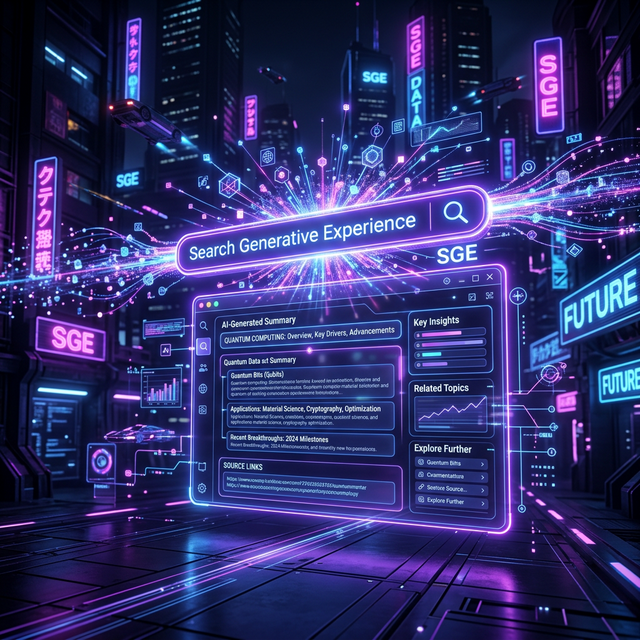
For two decades, SEO has been a game of ranking in the 'Ten Blue Links.' That era is officially ending. With the full-scale rollout of Google's Search Generative Experience (SGE), the top of the search results page is now a conversational, AI-generated summary. This shift has given birth to a new discipline: Artificial Intelligence Optimization (AIO).
AIO isn't about replacing SEO; it's about evolving it. The goal is no longer just to be the first search result, but to be the *trusted citation* that the AI model uses to build its answer. This requires a fundamental shift in how we create and structure digital content.
1. Quality Over Everything: The Rise of E-E-A-T
AI models are becoming incredibly good at spotting 'thin' content. Keyword stuffing and superficial summaries are now a fast-track to invisibility. To be cited by an AI, your content must demonstrate deep 'Experience, Expertise, Authoritativeness, and Trust' (E-E-A-T).
We are moving toward a 'Research-First' content model. Instead of writing for robots, we write for specialists. Highly specific, data-backed, and original insights are the only things that will survive the AI filter. At AD Fusionz, we help our clients turn their internal knowledge into high-authority digital assets that AI models love to reference.
2. Structured Data: The Language of Machines
If quality is the 'soul' of AIO, structured data is its skeleton. To quote your content, an AI needs to understand its context perfectly. This means implementating advanced Schema markup, JSON-LD, and clear hierarchical structures across every page of your site.
This technical foundation makes your content 'Machine Readable.' We treat every article as a collection of 'Data Entities.' By clearly defining relationships between people, products, and concepts on your site, we make it easy for Google's AI to include your brand in its generated snapshots. It's about speaking the AI's native language.
3. The Move from Keywords to Entities
Traditional SEO focused on individual words. AIO focuses on 'Entities'—the underlying concepts behind those words. An AI doesn't just see the word 'Marketing'; it sees an entity that is related to 'Advertising,' 'Growth,' 'Budget,' and 'Creativity.'
We help our clients build 'Knowledge Graphs' through their content. By covering a topic from every possible angle and linking those pieces of content logically, we establish our clients as the 'Entity Authority' in their niche. When the AI is asked a question in that field, our client becomes the undeniable source of truth.
4. User Intent in a Conversational World
People search differently when they are talking to an AI. They ask longer, more complex questions. 'Best agencies' becomes 'Which agency has the best track record for 3D creative in the performance marketing space?' Our content strategies are adapting to these 'Long-Tail Conversational Queries.'
We create FAQ hubs and 'Problem-Solution' clusters that mirror these real-world conversations. By anticipating the follow-up questions a user might ask an AI, we ensure that our clients stay relevant throughout the entire user journey, from initial curiosity to final decision.
Conclusion: Future-Proofing Your Visibility
The transition from SEO to AIO is the biggest change in digital visibility since the invention of the search engine itself. It can feel daunting, but for those who prioritize genuine quality and technical excellence, it is a massive opportunity. The 'noise' of low-quality content is being filtered out, leaving more space for brands that actually have something valuable to say.
AD Fusionz Team
Growth Strategists & Creators